
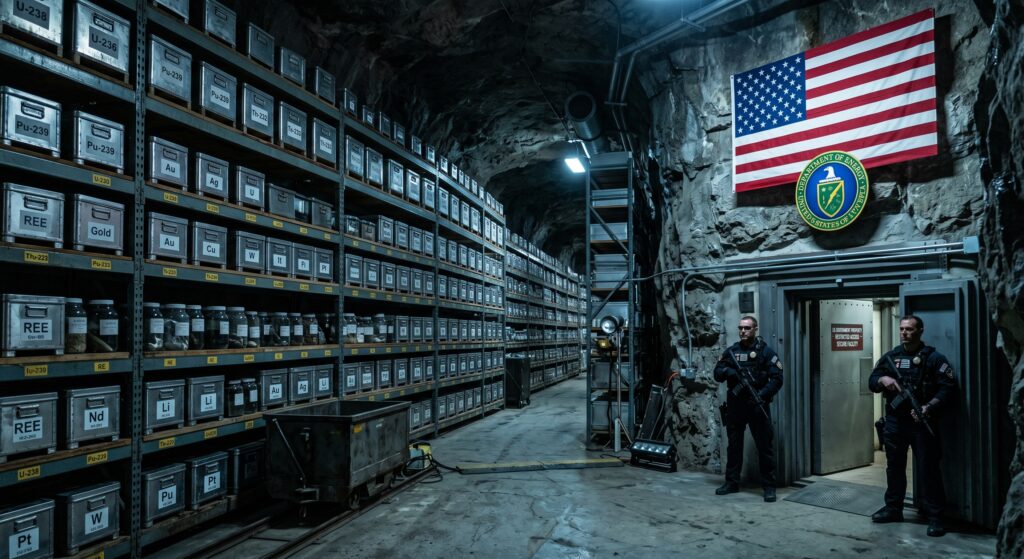
The United States has a problem it can no longer ignore. It is fully import-dependent for 12 critical minerals and relies on foreign sources for more than 50 percent of an additional 29 — minerals that underpin everything from F-35 radar systems and Tomahawk cruise missiles to electric vehicles, smartphones, and the power grid. China is the leading producer of 30 of the 60 minerals on the U.S. Geological Survey’s 2025 Critical Minerals List and controls refining for 19 of 20 strategic minerals tracked by the International Energy Agency, with an average market share of approximately 70 percent.
On February 2, 2026, President Donald Trump signed an executive order establishing Project Vault — the U.S. Strategic Critical Minerals Reserve — at a White House ceremony attended by administration officials and industry leaders including General Motors CEO Mary Barra. The Trump administration has described it as the most aggressive U.S. strategic stockpiling initiative since the Korean War.
| U.S. Mineral Import Reliance (2025-2026 Snapshot) | Dependence Level | Primary Import Sources |
| Natural Graphite | 100% | China, Mexico, Canada |
| Manganese | 100% | Gabon, South Africa, Australia |
| Rare Earth Elements (REE) | >90% (Refining) | China |
| Cobalt | 76% | Norway, Finland, Japan, Canada |
| Lithium | ~50% | Chile, Argentina |
| Nickel | 48% | Canada, Norway, Australia |
| Silicon | <50% | Brazil, Canada, Russia |
What Is Project Vault?
Project Vault establishes a physical strategic reserve of critical minerals for civilian use — the first of its kind in U.S. history. It is structured as an independently governed public-private partnership, distinct from the traditional Pentagon-managed National Defense Stockpile, and is modeled conceptually on the U.S. Strategic Petroleum Reserve (SPR). The goal is to shield American manufacturers from supply disruptions and price volatility driven by geopolitical risk, particularly from China.
President Trump described the initiative plainly at the signing ceremony: “We’re launching what will be known as Project Vault to ensure that American business and workers are never harmed by any shortage. Just as we have long had a strategic petroleum reserve and stockpile of critical minerals for national defense, we’re now creating this reserve for American industry, so we don’t have any problems.”
Unlike the SPR, however, Project Vault is not a reserve authorized by Congress. The SPR was created under the 1975 Energy Policy and Conservation Act. Project Vault instead relied on existing authorities of the Export-Import Bank of the United States (EXIM), allowing the administration to move without seeking a congressional mandate.
When and Where
President Trump announced Project Vault on February 2, 2026. On the same day, the EXIM Board of Directors approved a direct loan of up to $10 billion — the largest financing in the bank’s 92-year history. Two days later, on February 4, 2026, Secretary of State Marco Rubio hosted the 2026 Critical Minerals Ministerial in Washington, D.C., bringing together representatives from 54 countries and the European Commission, including 43 foreign and other ministers, where Project Vault was formally presented to the international community alongside the launch of the Forum on Resource Geostrategic Engagement (FORGE).
Stockpiling can begin as participating companies submit their mineral requests. However, many implementation details — including how and where minerals will be stored physically, which private companies are contributing to the $2 billion private capital component, and what oversight mechanisms will govern the reserve — remain to be publicly disclosed.
The Budget
Project Vault deploys $12 billion in total capitalization:
- $10 billion via a direct EXIM loan — the largest in the bank’s 92-year history
- Approximately $2 billion in private capital from institutional investors
Private-sector participants already confirmed as contributors and supporters include commodity trading houses Hartree Partners, Traxys, and Mercuria Energy Group. Anchor OEM participants include Boeing, GE Vernova, Clarios, General Motors, and Western Digital, each of whom make long-term purchase commitments and pay fees in exchange for guaranteed access to stockpiled materials.
What Minerals It Will Cover
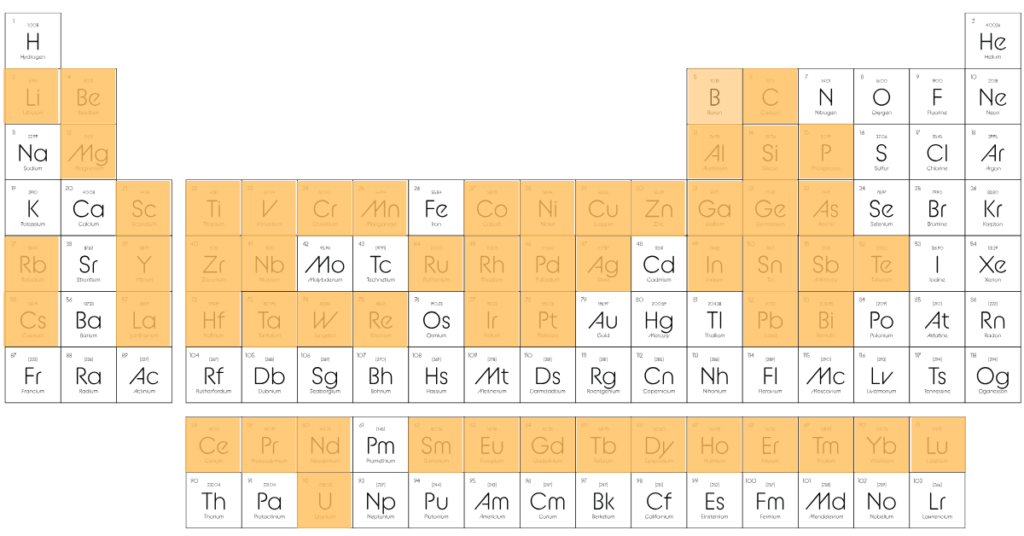
The stockpile will include all 60 minerals on the USGS 2025 Critical Minerals List, with an initial emphasis on rare earth elements. The 2025 list — expanded from 50 minerals in 2022 — added ten new minerals including copper, uranium, and lead. It is designed to provide a strategic buffer specifically for commercial manufacturers, not just defense contractors, representing a deliberate expansion of the reserve concept beyond its Cold War origins.
Among the minerals of highest concern are samarium, terbium, dysprosium, gallium, and germanium — all of which China placed under a new export licensing regime in April 2025, requiring case-by-case approval before they can leave the country. That action, widely seen as a response to U.S. tariffs, demonstrated exactly the kind of supply disruption Project Vault is designed to buffer against. Tungsten, used in jet engine components, armor-piercing ammunition, and cutting tools, also ranks among the top ten highest-risk minerals by USGS modeling and is explicitly covered by the reserve.
How It Works
Project Vault operates on a demand-driven model rather than centralized government forecasting. Participating original equipment manufacturers (OEMs) submit a list of the type and quantity of minerals they need. Those minerals are then acquired and placed into the stockpile on the company’s behalf.
To participate, companies must agree to two conditions: commit to purchase the minerals they are requesting at a fixed price at a later date, and pay any upfront costs and fees associated with storage and the EXIM loan interest. Companies can draw from the stockpile whenever necessary, but must pay the stockpile operator to replenish any minerals withdrawn at the same fixed rate agreed upon at enrollment.
The administration has also taken direct equity stakes in mining companies as a complementary mechanism. Companies in which the government has taken equity positions include:
- MP Materials: A 15 percent stake was taken by the Department of Defense (Department of War) following a $400 million commitment to support the Northlake magnet campus.
- USA Rare Earth: The government took a 10 percent stake for $1.6 billion, supporting a Texas mine and an Oklahoma magnet facility expected to begin commercial production in the first half of 2026.
- Lithium Americas: A 5 percent stake was acquired as part of a joint venture with General Motors to fund the Thacker Pass lithium mine in Nevada.
- Trilogy Metals: The government took a 10 percent stake ($35.6 million) to support copper and cobalt development in Alaska’s Ambler mining district.
- Vulcan Elements and ReElement Technologies: A $1.4 billion partnership focused on rare earth magnet manufacturing and recycling.
The Short-Term Supply Problem
Project Vault’s most significant structural challenge is timing. The average mine in the United States takes between 16 and 29 years from initial exploration to commercial production, a timeline driven by resource drilling, feasibility studies, environmental review, permitting, financing, and construction. No stockpile announcement changes that geological and regulatory reality.
In the short term, the reserve’s primary function is as a buffer — buying time for alternative supply chains to mature, not replacing them. Industry analysts estimate three to seven years before meaningful new domestic capacity comes online, even under the most optimistic permitting scenarios. The uncomfortable question that remains publicly unresolved is where the minerals filling Project Vault will come from in the near term, given that much of the world’s refining and processing capacity for critical minerals — including for rare earths — remains concentrated in China.
To address the permitting bottleneck on the domestic front, the Trump administration declared a National Energy Emergency on January 20, 2025, and in April 2025 the Department of the Interior released emergency alternative arrangements for NEPA compliance, compressing environmental impact statement timelines from a multi-year process to 28 days at most.
The first project approved under those emergency procedures was Anfield Energy’s Velvet-Wood uranium and vanadium mine in San Juan County, Utah — a critical minerals project cleared in just 11 days in May 2025. Interior Secretary Doug Burgum called it “a turning point in how we secure America’s mineral future.” Uranium and vanadium are both on the USGS 2025 Critical Minerals List.
However, the legal durability of the 28-day framework is actively being contested. On May 9, 2025, a coalition of 15 state attorneys general filed suit in federal court in Washington state, challenging the administration’s use of emergency authority to bypass environmental review. On January 30, 2026, that coalition expanded its complaint to add the Department of the Interior as a defendant, alleging that DOI unlawfully invoked emergency authority because no qualifying emergency existed as defined by the agency’s own NEPA-implementing regulations. The case — State of Washington v. Trump, No. 2:25-cv-00869 (W.D. Wash.) — remains active.
The Bull Mountains coal mine expansion in Montana, which became the first major mining project to receive a completed EIS under the 28-day alternative arrangements in June 2025, was subsequently sued by conservation groups in March 2026 in federal district court in Billings. Critics further noted that approximately 96 to 99 percent of the mine’s coal is exported to Asian markets — including Japan, South Korea, and China — directly challenging the administration’s domestic energy emergency rationale.
Any critical mineral project approved under the 28-day process faces the same litigation risk. A permit granted in weeks can be frozen in federal court for years, potentially recreating the very delays the policy was designed to eliminate.
The International Architecture: FORGE
Project Vault does not stand alone. It is the domestic centerpiece of a broader three-part framework the administration has assembled:
- Project Vault — provides immediate supply security for U.S. manufacturers via the physical reserve
- Bilateral pricing agreements — establish market stability mechanisms with allied nations via price floors and offtake frameworks
- FORGE ( Forum on Resource Geostrategic Engagement )
— a 54-nation preferential trading bloc for critical minerals, announced on February 4, 2026, as the successor to the Biden-era Minerals Security Partnership
At the February 4 Critical Minerals Ministerial, the United States signed 11 new bilateral critical minerals frameworks or memorandums of understanding with countries including Argentina, the Cook Islands, Ecuador, Guinea, Morocco, Paraguay, Peru, the Philippines, the United Arab Emirates, the United Kingdom, and Uzbekistan — joining 10 other frameworks signed in the preceding five months.
The administration’s theory of change is that these mechanisms must function together as an integrated system. A stockpile alone provides a buffer. Bilateral pricing frameworks provide market stability. FORGE provides the long-term trade architecture to ensure that non-Chinese supply chains are commercially viable and enforceable. Whether the three function as designed depends on implementation details that are still being written.
What It Means for the Mining and Exploration Industry
For the U.S. mining and exploration sector, Project Vault represents a structural shift in the risk profile of critical mineral projects — even if it does not change their development timelines. Federal backing via EXIM financing, equity stakes, and offtake-linked pricing mechanisms reduces the single greatest barrier facing junior exploration companies: the inability to secure commercial financing without a guaranteed buyer.
Companies holding critical mineral assets in the United States — particularly those with resources in rare earth elements, tungsten, lithium, cobalt, and the other minerals on the USGS list — are now operating in an environment where the federal government has effectively signaled it may become one of the sector’s largest and most creditworthy customers. That changes the economics of exploration, the calculus of investor due diligence, and the strategic value of domestic mineral deposits in ways that will take years to fully materialize — but are already reshaping how the industry is being capitalized and prioritized.
The critical minerals race is no longer a geological question. It is a geopolitical one. And Project Vault is the United States’ opening move.
What minerals our on the list? See complete list here
Sources: U.S. Department of the Interior; EXIM Bank; U.S. Department of State 2026 Critical Minerals Ministerial; USGS 2025 Critical Minerals List; Geopolitical Monitor; Bipartisan Policy Center; Harvard Environmental & Energy Law Program; Colorado Attorney General’s Office; Earthjustice; Bureau of Land Management; National Law Review; FGS Global; Mayer Brown; Perkins Coie.