
Choosing the wrong drilling method can cost a project significant delays and budget overruns, and worst of all it can reduce the critical data that is needed to advance to the program to the next stage. Drilling is one of the most consequential decisions in any exploration program.
The optimal method depends on several interconnected factors: deposit type, target depth, terrain, budget, and the specific data requirements of your program. A poor choice may produce data that a Qualified Person cannot certify as adequate for resource reporting under NI 43-101 or JORC, requiring additional drilling with an appropriate method, setting the project back by months or years.
Below is a practical guide to the five most common exploration drilling techniques, when to use each one, and a quick-reference comparison table to help frame your decision.
KEY POINT: Before selecting a drilling method, complete your property acquisition, assemble a qualified geological team, and finish the required archaeological and environmental assessments. Drilling program design follows those foundational steps, not the other way around.
The Five Exploration Drilling Methods
#1: Diamond Core Drilling Cost Category: High
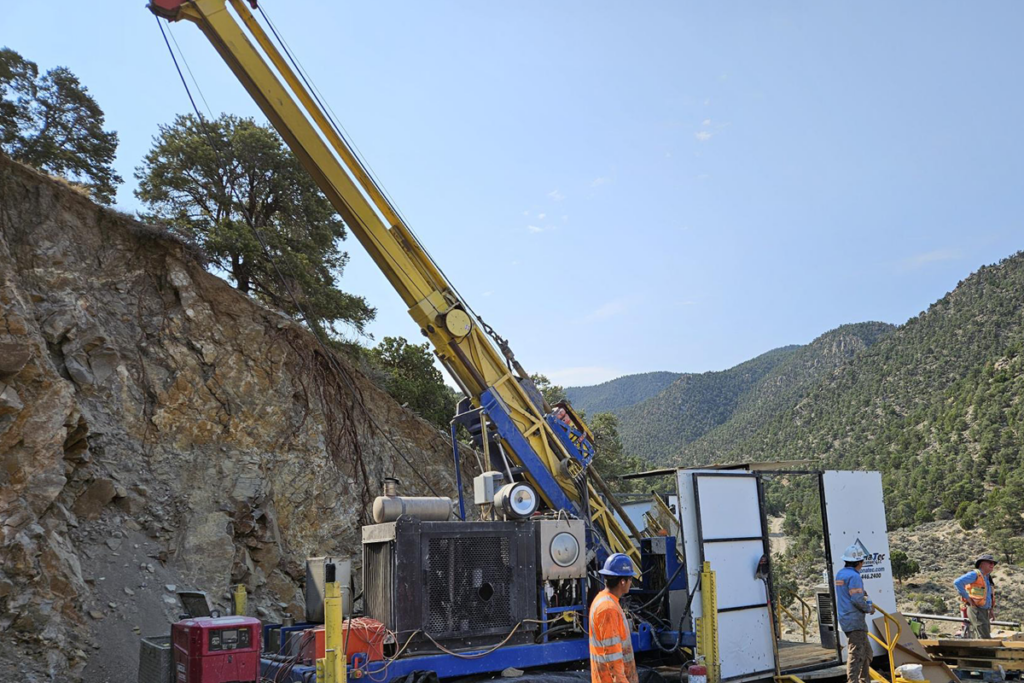
Diamond core drilling is the preferred method when superior sample quality is essential for geological, structural, or geotechnical analysis. Using a diamond-impregnated bit, it retrieves continuous cylindrical rock cores from depths typically up to 1,200 meters, with some operations exceeding 3,000 meters.
This method excels in competent hard rock geology, providing exceptional data fidelity for modelling ore bodies and determining mineralization controls. Despite its higher cost and slower penetration rate, its unparalleled sample quality makes it the standard for resource definition and feasibility studies.
Best for:
- Deep targets in competent hard rock where sample integrity is non-negotiable
- Resource definition drilling requiring NI 43-101 or JORC compliant resource reporting
- Metallurgical sampling for processing and recovery test work
- Feasibility studies and geotechnical investigations
- Structural geology analysis requiring oriented core
- Underground drilling programs targeting depth and lateral extensions of mineralization
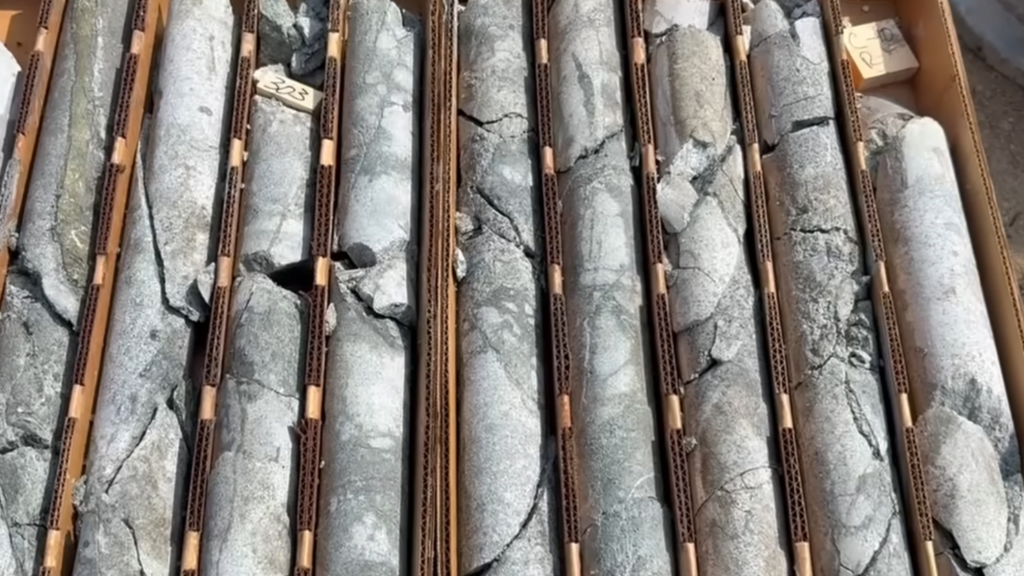
Bottom line: If your target is in hard rock and the data will support a resource estimate or feasibility study. Pay for core. For reconnaissance or shallow programs, RC will answer the question at a fraction of the cost.
#2: Reverse Circulation (RC) Drilling Cost Category: Moderate-High
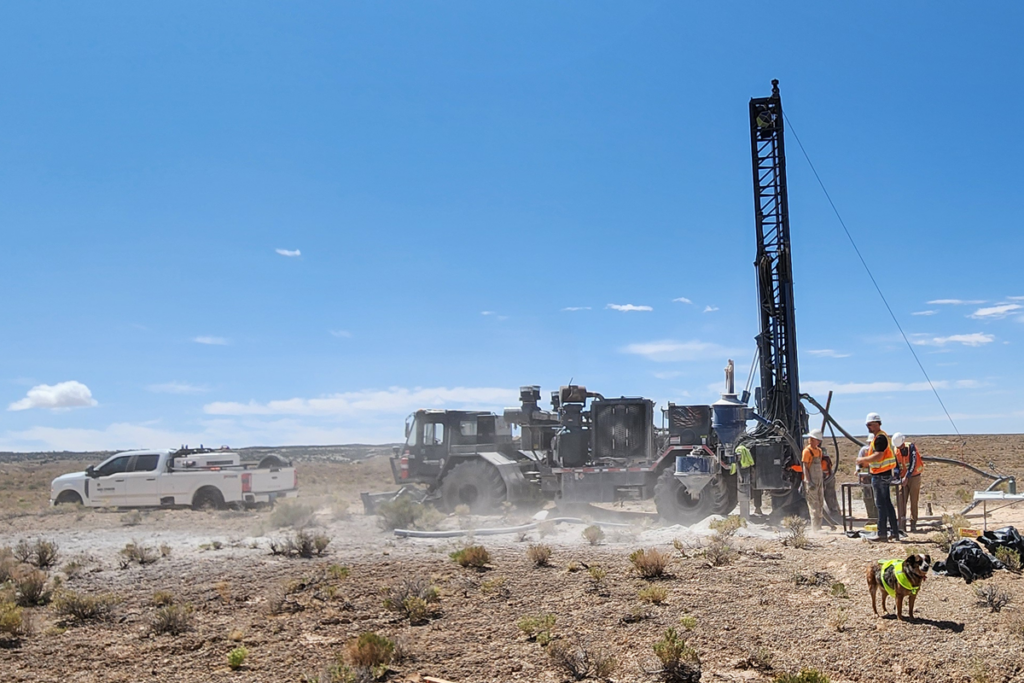
Reverse Circulation drilling employs a dual-tube system where compressed air powers a downhole hammer at the bit face, with return air lifting rock chip samples to the surface through the inner tube, which keeps the sample separated from the borehole wall and eliminates contamination.
While chip samples lack the structural detail and orientation data available from core, they provide consistent, representative grade data suitable for resource delineation. RC drilling is effective from surface to depths of approximately 600 meters, with extensions to 1,200 meters achievable under favorable conditions.
Best for:
- Preliminary exploration and initial resource delineation
- Infill drilling programs where grade continuity is the primary question
- Large-scale programs where drilling speed and cost per meter matter
- Follow-up on diamond core results to expand coverage efficiently
- Grade control drilling in open pit mining operations
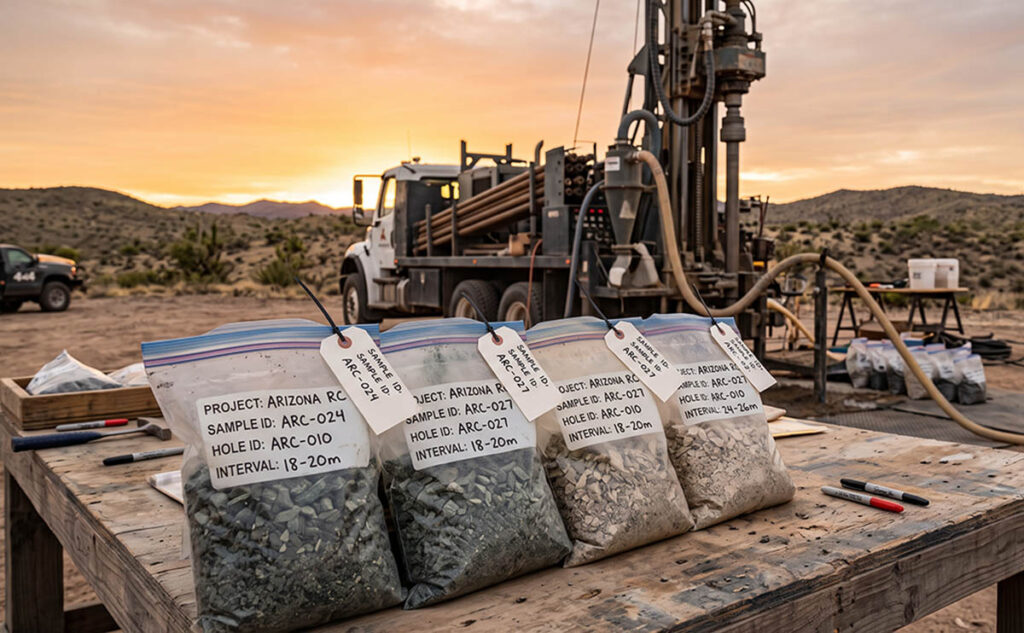
Bottom line: RC is the industry workhorse for good reason, it’s fast, cost-effective, and reliable enough for most exploration and resource delineation questions. When structural detail or deep targets demand it, step up to core.
#3: Rotary Percussion (DTH) Drilling Cost Category: Moderate
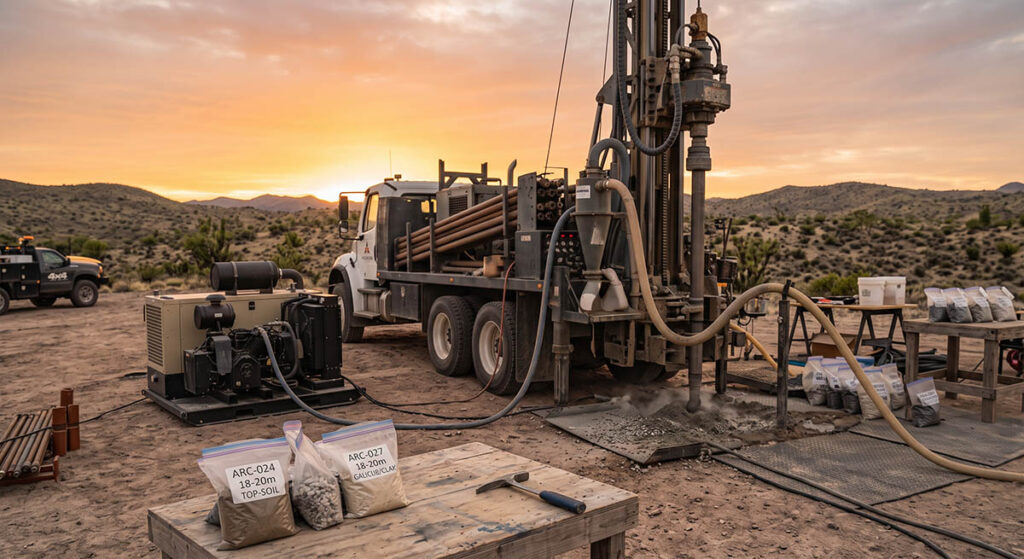
Down-the-hole (DTH) drilling combines a percussion hammer at the bit with rotary motion, enabling high penetration rates in very hard rock at depths typically up to 350 meters, though capable of exceeding 2,000 meters. The hammer operates at the bottom of the hole, immediately above the drill bit, minimizing energy loss through the drill string.
Producing coarse chips, it offers moderate sample quality but excels in cost efficiency for difficult geological conditions where other methods struggle with penetration rates. DTH is well-suited for reconnaissance drilling or areas with overburden refusal.
DTH is also widely used beyond mineral exploration — including blast hole drilling in quarry and open pit operations, water well construction, and foundation pile installation in rocky ground.
Best for:
- Reconnaissance drilling in very hard rock formations
- Areas with overburden refusal where rotary methods cannot advance
- High penetration rate requirements at moderate cost per meter
- Early-stage programs where broad geological coverage is the priority
- Blast hole drilling in open pit and quarry operations
- Water well drilling through competent bedrock
- Foundation and pile installation in rocky ground conditions
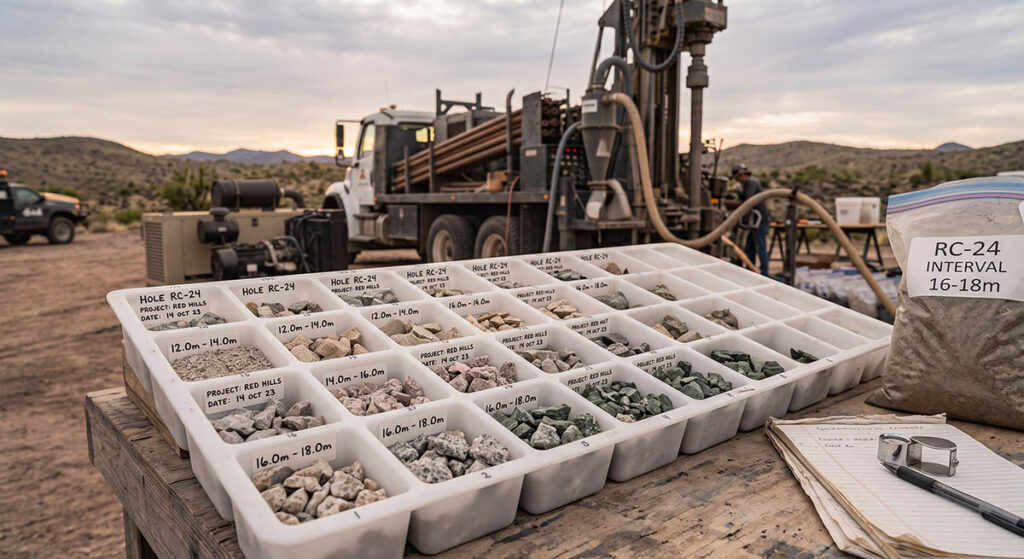
Bottom line: DTH is the go-to method when hard rock is defeating other rigs. It sacrifices sample quality for penetration power. Use it when speed and cost per meter matter more than detailed geological data.
#4: Auger Drilling Cost Category: Low
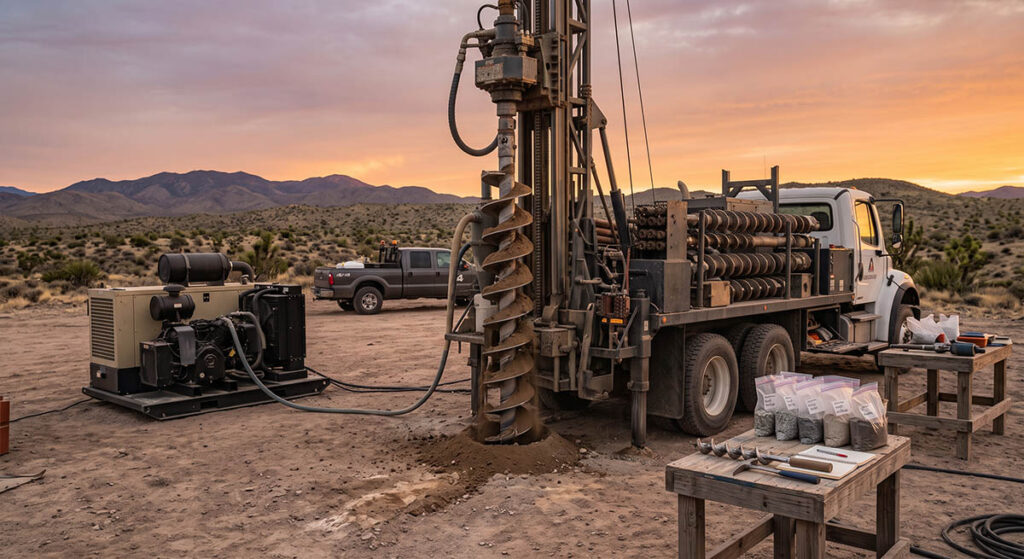
Auger drilling is a lightweight, low-impact method ideal for shallow investigations of less than 30 meters in soft, unconsolidated soils. Using a helical screw bit, it extracts disturbed soil samples for surface geochemical surveys and identification of transported overburden.
While limited in depth and sample integrity and unsuitable for hard rock, auger drilling is valuable for early-stage prospecting and environmental baseline studies. It is particularly effective for determining overburden depths before committing to more expensive methods.
Best for:
- Surface geochemical sampling programs in soil cover
- Early-stage prospecting to characterize cover sequences
- Environmental baseline studies requiring shallow soil data
- Overburden depth determination ahead of deeper drill programs
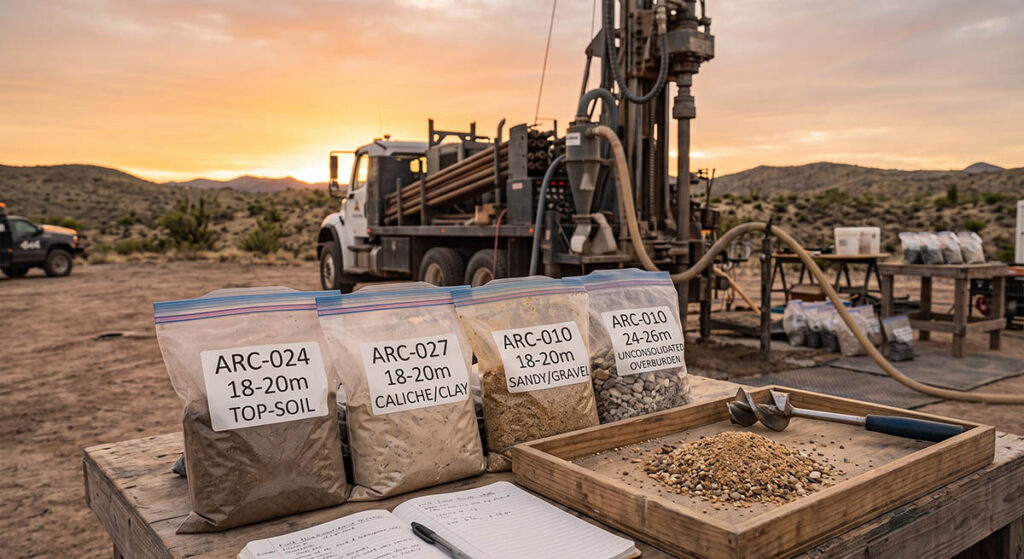
Bottom line: Auger is the right tool for understanding what is covering your target before you spend serious money drilling through it. Simple, fast, and inexpensive, but know its limits. Once you hit hard rock or need reliable grade data, you need a different rig.
#5: Sonic Drilling Cost Category: High
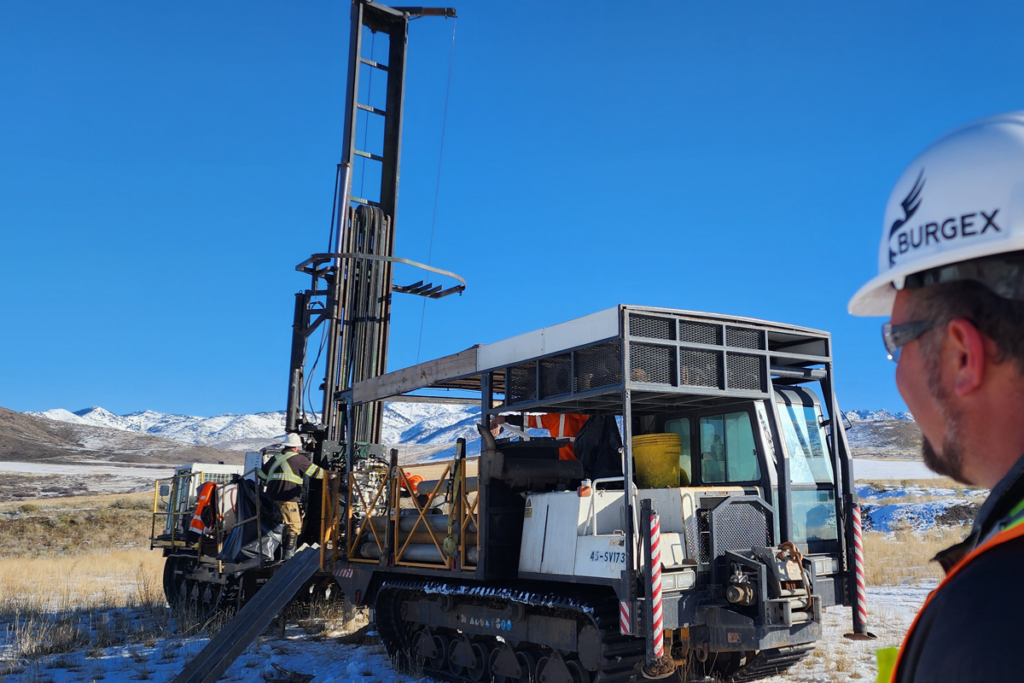
Sonic drilling employs high-frequency vibration combined with rotary motion to extract near-continuous core samples, typically from 30 to 120 meters, and occasionally up to 230 meters. The resonant energy temporarily fluidizes the material immediately around the bit, dramatically reducing friction and allowing near-undisturbed sample recovery in conditions that defeat conventional methods.
It excels in overburden and unconsolidated formations, where traditional rotary or percussion methods struggle with recovery or sample disturbance. Sonic drilling provides high-resolution stratigraphic data that no other method can match in soft or complex ground conditions.
Best For:
- Placer gold and mineral deposit investigations in unconsolidated sediments
- Aggregate exploration requiring continuous stratigraphy
- Groundwater studies and environmental assessments
- Boulder-strewn alluvium where other methods cannot maintain sample integrity
- Unconsolidated soils including sand, gravel, silt, and clay where conventional boreholes risk collapse
- Mixed boulder and cobble ground, glacial till, and placer deposits that defeat conventional bits
- Sensitive earthworks including levees and embankment dams, where conventional percussion or jetting methods risk erosion or structural disturbance
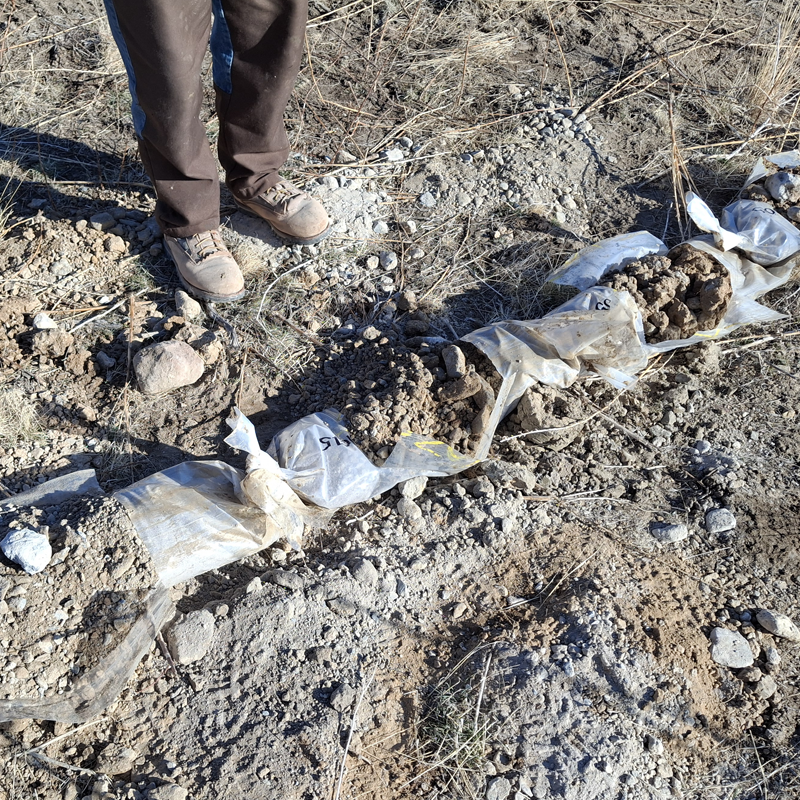
Bottom line: Sonic is the specialist’s tool for ground that defeats everything else. If your target is buried under complex unconsolidated material and sample quality matters — sonic is worth every dollar of its premium cost.
Exploration Drilling Methods: Quick-Reference Comparison Table
Use this table as a starting framework. Every project is different with site-specific conditions, geological targets, and program objectives will always require an experienced geologist to validate the method selection before finalizing method selection and engaging a drilling contractor.
| # | Method | Cost | Max Depth | Sample Quality | Best Used For | Tier |
|---|---|---|---|---|---|---|
| 1 | Diamond Core | High | 3,000 m+ | Excellent | Resource definition, feasibility studies, NI 43-101 & JORC reporting, metallurgical sampling, structural geology | Primary |
| 2 | Reverse Circulation (RC) | Moderate | 2,000 m | Moderate | Hard rock reconnaissance, overburden refusal conditions, blast hole drilling, early-stage coverage | Secondary |
| 3 | Rotary Percussion (DTH) | Moderate | 2,000 m | Moderate | Hard rock reconnaissance, overburden refusal conditions, blast hole drilling, early-stage coverage | Secondary |
| 4 | Auger | Low | 30 m | Low | Soil sampling, early-stage prospecting, overburden depth determination, geochemical surveys | Secondary |
| 5 | Sonic | High | 230 m | Good–Very Good* | Placer deposits, aggregate exploration, environmental studies, complex unconsolidated ground | Specialist |
TIER LEGEND
- Primary: Core mineral exploration methods – used on the majority of exploration programs
- Secondary: Support and early-stage methods – valuable at specific program phases
- Specialist: Niche methods – best in class for specific ground conditions or deposit types
Key Considerations for Method Selection
Selecting the right drilling method is not a desk exercise. It requires integration of geological knowledge, site-specific conditions, budget realities, and program objectives. The following principles should guide every method selection decision.
Hard Rock vs. Unconsolidated Ground
Core and RC drilling are the primary choices for hard rock exploration across most mineral commodities. DTH and top hammer rigs can support cost-effective sampling in early-stage programs where lower sample quality is acceptable. Sonic, Becker hammer, and auger drilling are better suited for placer and alluvial mineral investigations, geotechnical applications, and environmental baseline programs in soft or unconsolidated ground.
Depth and Data Requirements
If your target is shallow and the program goal is broad reconnaissance, speed and cost per meter dominate the decision. If you are at the resource definition stage — preparing for a NI 43-101 resource estimate or feasibility study — sample quality is non-negotiable and diamond core is almost always the right answer, regardless of cost.
Terrain and Access
Equipment size, weight, and mobility constraints can override geological preferences. A sonic or diamond core rig may be technically ideal but physically inaccessible in steep terrain or remote locations. Heliportable RC or DTH rigs may be the only practical option in certain environments, and the program design should reflect that reality from the outset.
The Role of the Geologist
Method selection should never be delegated to a drilling contractor alone. An experienced geologist serving as your project manager brings site-specific geological knowledge, understands what the data needs to achieve at each program stage, and can identify when field conditions require a method change mid-program. Poor method selection or failure to adapt when conditions change can leads to schedule delays, budget overruns, and data gaps that cannot be recovered later.
BURGEX TIP: Before finalizing your drilling method, engage a qualified project geologist to review your geological model, target depth, terrain constraints, and data requirements. The cost of that consultation is negligible compared to the cost of drilling the wrong holes the wrong way.
Planning Your Exploration Drilling Program?
Burgex Mining Consultants provides full-service exploration support, from drill program design and method selection through to field execution, sample management, and technical reporting. Our senior geologists have managed drill programs across a wide range of commodities, deposit types, and jurisdictions throughout the United States.
We bring the field-level knowledge and project management experience to ensure your program collects the right data, in the right way, the first time.
Contact Burgex to discuss your project: www.burgex.com/contact-us